Tag: leadership

  • 3 Keys to Effective Organizational Communication

    3 Keys to Effective Organizational Communication

    [vc_row][vc_column][vc_column_text]

    [/vc_column_text][/vc_column][/vc_row][vc_row][vc_column][vc_column_text]

    3 Keys to Effective Organizational Communication

    Minimizing frustrations across many levels

    By Dr. Ted Sun 

    You made significant efforts to create an effective plan to launch a project. It took months to integrate all the moving parts. You’ve communicated it multiple times throughout the organization. When kickoff starts, nothing is going as planned. Very few people are doing what they are supposed to do. How frustrating is it to see numerous problems arise when it seems that very few people stuck to your plans?

    Unfortunately, this is all too common in numerous organizations, from established corporations to firms looking to grow. The impacts of effective communication can be seen on many levels, including employee retention, project budgets and timelines, service delivery, customer satisfaction, burnout, workplace stress, productivity, etc. Communication is much more than a skill working with the hierarchies of an organization. Successful organizations design communications from a systems perspective, synthesizing technology, leadership skills, and memorable content. It functions within the hierarchy of the organizational structure, but also weaves through a web-like learning structure. It is so much more than a skill or a certificate program you complete in a few weeks.

    Hierarchy of Communication

    All organizations operate functionally with some type of hierarchy. While this is needed for work design and task completion, communication tends to be much more lucrative and often not linear. At the executive level, leaders often don’t get accurate information on problems fast enough; by the time they become aware of the problem, it’s distorted through many layers of the organization. This creates ample frustration and a constant need to solve major problems.

    At the lower levels, many lack the full information needed to perform their jobs. For example, one organization made strategic changes in product pricing and delivery to be more competitive in the marketplace. While it made perfect sense at the top level, how it gets implemented failed to get to the lower levels. The team on the ground felt stupid for not knowing these changes in the system, and now they have to go back to the customers and change all the work they had completed. While it makes perfect sense for information pertinent to the job to be transparent at the lower levels, how it’s communicated makes a world of difference. Too often, an email isn’t enough. The communication problem often bleeds into new employees as onboarding information rarely reflects the constant adaptations of strategy at various levels of the organization, leading to more problems down the line as new employees step into their roles. To overcome these communication problems across the entire organization, successful organizations use a systems approach to communication.

    3 keys to Effective Communication Systems

    Communication is the lifeblood of organizations – this is one of the few statements I recall from one of my professors, Jeff Ford. After decades of research, publishing, teaching, and consulting, this statement has always been at the heart of almost every engagement.  While designing communication systems involves numerous elements, we’ll speak to three of the most important keys.

    1. Memorable Content: Any communication requires content that is meaningful and memorable. Every human being is exposed to 11 billion bits of data each second. Most of that data is ignored. Approximately 40-50 bits of data get consciously processed by our brain. But processing data does not become long term memory. This is a common flaw in many training programs where people assume that exposure to new information equates to knowledge gained. In reality, most of what we process is forgotten. For information to be memorable, emotional hooks in the brain must be consciously integrated into the contents. The stronger the emotion, the more likely it will become knowledge with sustained recall. This is where emotional intelligence and knowledge of your employees are key. What do your employees care about? How might you channel the content of your communication to something that’s meaningful for them? Organizational systems, such as employee inventory, have to support the content design from an emotional perspective.
    2. Synthesizing Technology: Technology seems to be abundant in today’s workplace. Too often, it gets very confusing. Technology such as emails, Slack, salesforce, etc. creates a myriad of options for information storage and transfer. At the core of technology, a knowledge management system is the centralized location organized for employee access. Employees need to know where they should look to find the relevant information quickly. We’ve seen organizations scatter different technology across various departments. One may use email more often, while another department uses Slack. And they point to different sources like Salesforce or Microsoft dynamics (such as Teams and others). How people leverage a centralized technology system leads toward considerations at the source of information.
    3. Leadership skills: While conventional wisdom tends to speak to communication skills in general, we’re exploring this with a wider lens. Communication skills are composed of numerous skills such as active listening and Socratic methods. They also require alignment of specific values that form healthy perceptions of people, which extends into the leadership realm. Consider managers who see their team as people who are there to perform a task dictated to them or goals set for them; their desire to communicate will be limited. We’ve seen many top-level executives apply a collaborative communication approach with their peers, and apply a dictator approach with lower level employees. Especially with new generations, how you communicate is more than half the battle. Leaders need to be conscious of how they are communicating more than ever in order to be inclusive and let their employees’ voices be heard. No matter what kind of content is being communicated, numerous leadership skills are needed to effectively get the message across. I recently ran a number of sessions in a larger program focused on asking open-ended, empowering questions. It was amazing to see the leaders’ struggles with asking open-ended questions. Their organizational culture has drowned them with close-ended and limiting questions for many years that it’s very hard to retrain their minds. Such skills are crucial for plans to be effectively executed.

    As you explore the systems of communication within your organization, consider this question – if you are not there, who’s sharing your knowledge in a way that others will remember and effectively execute?  This is where you begin to explore communication at the systems level – not by any one individual or a group, but through a system that maximizes retention.

    We’ll leave you with one consideration: Effective communication is the response you desire.

    Let’s explore how to enhance your communication systems to minimize communication problems and drive the results you deserve. And, more importantly, let’s do it so you have more control of your schedule and not be frustrated with people not listening. Email Cody – Cmcmichael@tc-university.org

    [/vc_column_text][/vc_column][/vc_row]

  • Endless Organizational Problems

    Endless Organizational Problems

    [vc_row][vc_column][vc_column_text]

    [/vc_column_text][/vc_column][/vc_row][vc_row][vc_column][vc_column_text]

    Endless Organizational Problems

    A Fundamental Leadership Flaw – Too Many Problem Solvers

    By Dr. Ted Sun & Cody McMichael

    Most Executives are finding it challenging to take control of their schedules. When asked about this organizational reality, they speak of the endless problems that arise. A recent Deloitte research study found that nearly 70% of executives are overwhelmed and are looking for another job.  But is there a way out of this reality?

    Unfortunately, the answer is NO. The fundamental leadership issue behind a lack of control and stress is having too many problem-solvers. What happens when you have an abundance of problem-solvers? They need a problem to solve, so they wait for a problem. When problems happen, their skills are validated and they feel needed. However, by the time a situation becomes a problem, it is very costly to the organization from a resource, finance, and timeline perspective. To understand how to get out of the rat race of constant fire-fighting with endless stressful problems, you have to look at the conventional wisdom in almost every job description of managerial roles and the systemic nature of problem-solving.


    The Problem Addiction: How did we get here?

    Take a look at your job description; one of the key skills required for most supervisory or management jobs includes being a problem solver. You will find the skill stated in learning outcomes for formal education and corporate training – develop problem-solving skills. At a young age, kids are taught how to solve problems in school. When you get to the university level, problem-solving becomes more and more complex, as more challenging problems are thrown at you. For example, many business schools use case studies to develop limited problem-solving skills. In all of these instances of developing problem-solving skills, problems are given to the learner, whether on a piece of paper or in some simulation. The basic assumption is that the problem is already happening. In the real world, how many problems are given to you on a piece of paper? The lack of problem identification and clarification creates a reactive mentality where problems must happen first so one can only react to them. Leaving little to no room for strategic thought, only reactionary choices.

    With the countless leaders who possess problem-solving skills, they are taught to wait for a problem to be given to them. Only then can they validate their ability to solve the problem. Too often, the challenge of a timely response to a problem does not enable a deeper exploration of the many influences as to why it happens (systemic analysis). As a result, band-aids are used to address only the surface issues. For example, we’ve seen numerous companies deal with the problem of talent retention. As they see their talent quit, it is already too late. They struggle to make quick and uninformed decisions, trying to keep their talent at the last minute, such as using a surface band-aid of throwing money at people. In most cases, these actions fail to keep the talent. While blame becomes easy, the responsibility to avoid this constant loss of talent requires a preventative approach and systemic thought. Only systemic changes can address the root problem and prevent it from happening.

    Outcomes of Problem-Solving

    The outcomes of having many problem-solvers result in many people waiting for problems to solve. At the individual level, constantly fire-fighting problems creates overwhelming stress at all levels of the organization. Research has shown that the average executive is forced to reschedule approximately 73% of their meetings in any given week. Furthermore, being forced to react forces leaders away from using their higher-order thought processes and toward basic survival instincts. While strategic thought is needed, leadership mentality is stuck in a survival box making misinformed decisions.  We’ve all played the telephone game where one starts with a single sentence and sees how that sentence gets changed by the time it moves down a few people. Complex problems at the organizational level are exponentially worse by the time leaders are informed of the problem.

    At the group level, constant problem-solving significantly impacts the morale of the team. While a few may get the thrill of being needed in the short run, constantly having to change what you’ve planned to do gets old very quickly. When dealing with one problem after another, the team’s workload continues to mount as time is stolen for problem-solving.

    At the organizational level, one of the primary reasons why most projects fail to meet schedules and budgets is that too many people are waiting for a problem to land on their desks. We have seen some very well-thought-out plans for launching new products and services fail to be executed. With many problem-solvers not knowing how to prevent a problem from happening, every plan finds itself with numerous problems once implementation begins. While the financial costs are often measurable, the intangible costs to the organization can be crippling. We recently witnessed an organization outline a 6-month plan for launching a new product that took well over a year. By the time it was completed, employee morale was at an all-time low; quiet quitting was abundant; and, even at the leadership levels, many sought new jobs before we were engaged.

    A Systemic Solution: Developing Problem Preventers

    To address the problem of too many problem-solvers, successful organizations make a conscious effort to develop problem-preventers

    . Leaders who can effectively and efficiently identify problems before they become costly. This requires key skills, like systems thinking, that go well beyond the surface, and designs systems that drive desired outcomes. While problem solvers are always needed, balancing them with problem-preventers enables leaders to get out of the rat race of constant firefighting problems. This is not a short course in the traditional realm of leadership development certificates. Developing problem-preventers is a long-term and integrated development program that we have fine-tuned after decades of global research and experience. This is well worth the effort when leaders find more control in their schedule and work can be more enjoyable with time for strategic thought. In a recent engagement, one executive shared his reflection: “I never thought I’d see more and more people coming into my office sharing the solutions to possible problems which they’ve already begun to implement to avoid a major issue in the future.”

    Every organization needs more problem-preventers. Start the development today by asking every leader and executive how they can prevent current problems or similar ones in the future. Guide your leaders toward going beyond what’s in front of them.

    Let’s chat about your organization and see how we can make a significant impact on your culture, level of control, innovations, and success. Email Cody – Cmcmichael@tc-university.org

    [/vc_column_text][/vc_column][/vc_row]

  • Who Wants Loyalty to Money?

    Who Wants Loyalty to Money?

    [vc_row][vc_column][vc_column_text]

    [/vc_column_text][/vc_column][/vc_row][vc_row][vc_column][vc_column_text]

    Who Wants Loyalty to Money?

    Overcoming The On-going Retention Challenge

    By Dr. Ted Sun & Cody McMichael

    Surprise! A vital employee left your team without much of a notice. As it turns out, this employee went to another organization for a $12,000 increase in annual compensation. Unfortunately, this is happening more and more often where organizational talent leaves for more money. While some organizations blame the departing talent, the toxicity of compensation-based reward system goes much further. Many organizations don’t realize that their existing compensation structure trains people to be loyal to money. It only gets worse in the struggle to find new talent. Organizational leaders often end up having to increase salary ranges to attract highly needed employees, which drives up costs and continues to reinforce employees’ loyalty to money. It becomes a vicious cycle that no one can win. This has to stop.

    Problems with Traditional Management Theories

    In many conversations with leaders across the world, no one wants to train their employees to be loyal to money. On the surface, we see salary demands increase across the board as inflation hits everyone’s pockets. Worse yet, the commitment to work continues to decrease. Traditional management theories are the primary influences on this reality. One of the basic assumptions in management practice is that employees are without intrinsic value. Work is a mere exchange between one’s time at work and financial compensation. While we have come a long way with numerous ideas about how to lead, most organizational systems fail to integrate those concepts into practice. Compensation structures are typically limited to financial compensation and a suite of benefits.  Managers often end up managing their employees’ time input for compensation.

    In one manufacturing organization, a few employees see a minor quality problem in the line. They know it will produce a small percentage of flawed items which they’ll have to come back and fix after the customers complain. Being paid for their time, they continue with the production run. This minor quality issue grows exponentially down the production line and becomes costly for the organization, not to mention to loss of trust from the customers. With a focus on time for money, it would only yield more overtime pay when they must come back and fix it. Unfortunately, the lack of care for the quality of work has increased over the last decade. It’s not uncommon to see employees, and even people at the senior management level, not care about the work they perform. It’s not uncommon now to see leaders make multiple commitments about completing a task in a certain time, and then to backout repeatedly. In some cases, it is due to the number of problems that haunt them. But in many, even a 15-minute task commitment gets ignored once work time is finished. Where is the integrity and responsibility in the workplace?

    A Systemic View of Employee Retention

    Two fundamental issues must be addressed to maximize employee retention. First, leaders need to approach this from a solution orientation, rather than a problem orientation, which is commonly taught in most educational organizations and consulting firms. We’ve gotten used to looking at exit interviews trying to learn how to avoid people leaving, and not enough time is spent on why people stay and continue to be engaged. In a recent analysis of a statement of work by a major consulting company, every aspect of the solution took a problem-based approach. They focused on data from exit interviews, analysis of current culture, and limited interviews with management. In trying to address the retention issue, this firm had no focus on what the ideal culture should look like. Furthermore, the statement of work had no mention of any organizational systems.  This brings us to the second fundamental issue of lack of systems thinking.

    Consider your workplace as a game that people come to play. Currently, it is often a game of come to work, whether remotely or in person, and get paid for your time. What if you changed the game to be much more interesting? Systems thinking enables leaders to see the various people systems that create the rules of the game. Integrating with solution orientation, why do your top talent stay and continue to be productive and exceed expectations year after year? Decades of research has shown that money is rarely ever the top reason. Looking at the systems that drive how employees perceive their workplace, it will involve several influences such as meaningful work; continued learning and growth; personal achievement; and, more importantly than ever since the pandemic, relationships. Almost every leader would say how important it is to build trust among their team, but how many have regular actions that systemically build trust on a daily or weekly basis? A trust system can build trust no matter who’s in charge, while ensuring it happens consistently across every department. Linear strategies are insufficient to maximize retention. When leaders take a solution orientation approach and implement carefully thought out systems, they can achieve over 90% talent retention, along with many other desired outcomes.

    Beyond Generic Engagement Strategies

    Tackling talent retention requires the fundamental skills of solution orientation and systems thinking. It is much more than generic engagement strategies, which often require systems support. For example, if you taught active listening to all of your management, what systems would support the mastery of this skill? How would you know that the prerequisite of this skill exists in the healthy perceptions of team members? Is there a safe learning environment in which to practice? What holds people accountable to applying what they were taught? How is performance management integrated with this new skill, along with emotional pay for the management and their respective teams? These are just some of the questions that challenge leaders to go beyond generic strategies and begin to think at the systemic level.

    In a time where we feel like we are more connected than ever through all our technologies and social media, we are more disconnected than ever. We no longer have to plan to go to the stores for anything. With a few clicks, individual products show up at our doorstep. Many rely on instant messages for surface level communications. Meaningful conversations that build the depth of respectful and trusting relationships are not as common as they used to be. Being disconnected is costly for any organization. Survival isn’t enough when the market is changing and society is becoming less connected. The workplace has no choice but to build the community to thrive with limited human resources. Especially with larger and more powerful competitors fighting for talent, like Amazon, Facebook, and Intel, strategic leaders need to design and implement people systems that get the best from every employee.

    A community that cares with a committed partner

    Imagine your workplace having a sense of community. A community of people working together to learn, grow, innovate, and produce something meaningful at the individual employee level as well as the organizational level. This community has an inclusive culture that radiates authentic care at every level. With Transcontinental University’s global expertise and EduSulting approach, your organization can achieve this level of employee engagement. We can develop your leaders to master the necessary skills needed to implement various systems while providing guidance towards seeing the systemic nature of organizational design and strategies. Let’s explore how to move your employees away from being loyal to money and start building a meaningful community that makes work productive and engaging. Email Cody – Cmcmichael@tc-university.org

    [/vc_column_text][/vc_column][/vc_row]

  • 3 Ways to Retain Your Talent and Master Organizational Stress

    3 Ways to Retain Your Talent and Master Organizational Stress

    [vc_row][vc_column][vc_column_text]

    [/vc_column_text][/vc_column][/vc_row][vc_row][vc_column][vc_column_text]

    3 Ways to Retain Your Talent and Master Organizational Stress

    Synthesis of Knowledge and Strategy

    By Dr. Ted Sun & Cody McMichael

    45% of employees are looking for a new job!

     Two out of three employees have challenges with their well-being!

    Findings from the  2022 State of the Global Workplace report by Gallup are alarming. With workplace stress at an all-time high, no wonder many employees are looking for new jobs. With a recession creeping in, most organizational leaders are struggling to find a systemic solution across their entire organization.  Worst yet, those in the C-suite, who are supposed to be finding a solution to the problem, are also seriously considering quitting their jobs. A recent Deloitte research found that nearly 70% of executives are overwhelmed and are exploring other job options.

    With these alarming numbers, what is your organization doing to make sure your leaders are engaged, healthy, and continue to innovate much-needed solutions?

    Pressures in the current workplace are higher than ever.  On the one hand, we face various challenges within the social justice movement that impact every employee. On the other hand, the ongoing problems with the supply chain require leaders to constantly adjust.  All of this equates to tremendous stress with limited support and development.

    Across our nation, quiet quitting or the Great Resignation is happening. To add to the complex business environment, as one example, Intel’s recent groundbreaking in central Ohio will create a major labor challenge – Ohio’s already strained job market and talent pool are going to be pushed to the breaking point.  The thousands of employees Intel intends to hire with high wages will have to come from somewhere. And that somewhere will likely be the overstressed, overworked, and overlooked employees looking for real change from organizations just like yours. That is if you don’t do anything about it immediately.  Creating a workplace of inclusion, belonging, and ideal stress levels for everyone to grow will take time. With Intel soon to begin hiring, this is a mandatory requirement to survive the scarce labor markets. Regardless of which state you have employees, scarce human resources are forcing leaders to reassess their strategies for talent retention.

    Leveraging decades of research and global experiences, we have created a 3-part strategic framework for organizations to retain their talent. This framework is built on principles and best practices within organizational psychology, leadership, and innovation. We call it StressEQ. It has three components: 1. People awareness, 2. Wholistic Growth, and 3. Strategic Relationships. Below is a very high-level overview of this strategic framework.

    People awareness: Knowing What You Don’t Know

    Stress is the primary cause of many organizational challenges from the mental health of the employees to the innovation level and retention rate of the organization. While it has many influences, most stress assessments barely scratch the surface. Knowing and understanding the stress levels and the sources of those stressors is what enables leaders to make effective strategic choices.

    Practical action: Create a stress journal for a few days. Write down specific stressors that you experience throughout the day and rank each stressor from one to ten.  Compare your stress journal with other colleagues and synthesize the common stressors in your organization.

    Knowledge is power. Knowledge about the specific stressors can provide a laser focus on effective interventions. While most stress tests only show limited stress at the macro level, we have identified eleven (11) stressors within organizations across three levels. The individual-level stressors are influenced by one’s values, beliefs, knowledge, and skills.  The team-level stressors are affected by relationships within the team or department. The organizational-level stress is created by strategic choices, such as hybrid workplace and change. Breaking down the different types of stress at the three levels provides incredible insight into making effective strategic choices to create the ideal-stress level that everyone grows and innovates.

    Holistic Growth: Move from Reactive to Proactive

    Now that we’ve identified a few of these stressors, let’s begin to explore the systems that create these stressors. Conventional wisdom tends to solve a stress problem as a single entity. This often leads to endless firefighting, moving from one problem to the next.  Instead, strategic leaders seek to enhance the systems that create optimal stress levels within an entire organization. Imagine an organization where strategic leaders are leading at all levels of the organization. This calls for the holistic development of leaders across the entire organization. This type of development takes, at minimum, a six-month journey of continued practice from new knowledge. It is definitely not the check-the-box and forgettable approach of most online courses that offer some video content and quiz questions to get a certificate. Teaching leaders to shift their thinking towards being proactive requires patience and ample practice in systems thinking. We all know the principle behind teaching a person to fish, instead of giving that person a fish.  With systems thinking, we move beyond conventional logic. We ask questions like why are we stuck to a fish? Why do we not design an ecosystem of different types of foods?

    The same is true for organizational DNA. The conventional approach wants ample problem solvers. Unfortunately, it never looks at the costs of always waiting for a problem to apply the skill. Strategic leaders need to move from a problem-orientation towards a solution-orientation where systemic thought is mastered.  Within this environment, we can move from always being reactive to being proactive.  As we look at retention numbers in any organization, the retention data tells you nothing about what to do to fix it. It is merely a latent metric by which leaders are judged. If numbers are negative, it is too late to get those people back and you have little information on what caused people to leave.

    Practical action: Reflect on the problems that have challenged your work environment. How many of them are similar and repeating problems? On a blank sheet of paper (no lines), draw a circular diagram of various influences on the current challenge you face. See the complexity of this challenge by identifying at least five different influences. Have others who face the same challenge do the same and see how many influences you can co-create.

    Talent retention and workplace stress are influenced by multi-functional levels. They are often integrated with what you do and how you do it.  When your leaders move from a reactive problem-based approach to a preventative ecosystem, challenges like workplace stress will lead to optimal levels where innovation is the norm and talent retention is consistently above ninety percent (90%). With more strategic leaders, you can get out of the constant firefighting and inject HOPE into organizational culture.

    Strategic Relationships: The Emotional Path to Loyalty

    Combining the knowledge of various stress levels and systemic thought, strategic leaders begin to visualize the various challenges that are embedded into conventional management systems. They begin to see the numerous relationships between people that drive loyalty.  They take time to intentionally develop relationships between themselves and their teams, as well as build trust and collaboration within the teams. Imagine a culture where leaders with insights from many stress journals across their entire organization are continually empowering their people. With leaders who are highly skilled in systems thinking, they create strategic interventions that address numerous organizational challenges, from workplace stress to innovation, fun, and retention.

    In one organization with a retention of 68% across the nation, they learned that the stress experienced by management and employees is very different. And, at each level, various stressors were inherent to several systems such as performance management, learning, and promotional systems. Each stressor needed a different type of intervention that addressed the root issues with a timely feedback system. Within three months of applying these tools and principles, they enhanced the level of inclusion and belonging by addressing systemic issues. And, after six months, they achieved greater innovation levels by inspiring the entire organization. They even exceeded their retention goals.

    Practical action: Before you start a meeting, get the emotional pulse of the participants. Ask people to share how they feel in a single word or two. The leader would write this emotion down to show the importance of what is being shared. Ensure there is no judgment or explanation needed for any emotion. Simply honor the emotion being shared. The content of this action will give you an emotional pulse to know whether your team is ready to start the meeting. The context (the how) of this activity will show your authentic care for your team members. And, if you find some troubling emotions, make sure your leaders have the skills to guide the group emotions to the right state.

    To dive deeper into your organization’s emotional pulse or culture, schedule a strategy session with us and see how Transcontinental University’s StressEQ can make a significant impact on retention in your organization!

    StressEQ is where passion meets purpose to create sustainable systemic change that drives organizations to grow positively into the future. It is an ECOSYSTEMIC tool that IDENTIFIES, MAGNIFIES, and RECTIFIES these stressors in real time to enhance talent retention and engagement.

    [/vc_column_text][/vc_column][/vc_row]

  • Developing Courage & Integrity

    Developing Courage & Integrity

    [vc_row][vc_column][vc_column_text]

    [/vc_column_text][/vc_column][/vc_row][vc_row][vc_column][vc_column_text]

    Developing Courage & Integrity  

    Necessities of leaders in turbulent times

    By Dr. Ted Sun & Anthony Nappi

    Recently featured in Forbes

    Being a leader has become significantly more complicated than before. Whether you’re a senior-level executive or a mid-level manager, making values-based decisions is not always as straightforward as maybe it once was. With influences like social media, extreme political activities, the pandemic, supply chain, and labor problems, knowing how to lead requires a conscious development of courage, integrity, and the foresight to understand the impact of your decisions.

    Current Influences

    Today’s cancel culture has silenced many people from all walks of life. The politically progressive social media has been a significant influence. In many instances, today’s leaders are being forced into making decisions predicated, not on their core values, but on how a small group of people with a loud voice will react. How do you find the courage to have your voice heard without violating your own values such as integrity, honesty, and respect?

    Challenging times require leaders who have the courage and integrity to do what’s right, regardless of the consequence. While the social justice movement has a strong foundation of inclusion, the practice of extremism and a sheer lack of critical thought can be frightening to anyone, regardless of their positions, education, and past achievements. There are countless examples of individuals who have lost their jobs, their colleagues, and, most importantly, their reputation for simply expressing an opinion that differs from a particular narrative.

    Defining Courage

    First, let’s explore courage and its numerous sources of power. We have all seen courage on the movie screen when a hero does something out of the ordinary to save the lives of others. In normal life, courage speaks loudly. When a person makes a values-based decision that is not popular, it is a form of courage. For example, when Levi’s Global Brand President Jennifer Sey quit her job and refused a million dollars in exchange for her voice, that is courage! One of the major sources of courage is knowing your own core values and what you stand for. Jennifer Sey was very clear on who she was and what she stood for, regardless of the political pressures or a million dollars. Ironically, I’ve done countless workshops across the world and it never stops amazing me how many leaders have not reflected and written down their core values, or have articulated the culture and values of their organization. Know who you are so you can be ready to draw the line in the sand when it’s time to make complex decisions that impact others.

    Courage in practice: Write down your top 5 values, define them in a sentence or two, and share them with others around you (family, workplace, social circles, etc.).

    Courage can also be seen in the sports world when athletes do something that has never been done. In the Tokyo Summer Olympics, four-time Olympic gold medalist Simone Biles withdrew from the all-around competition after realizing that her mind wasn’t in the right “headspace”. For someone who is arguably one of the best all-around gymnasts in the world, this was shocking to the world. Yet, she made it very clear that her own well-being came first. That took an incredible amount of courage!  Another of the greatest Olympians of our time is Michael Phelps, who had the courage to speak about his battles with ADHD and depression. His inspiration has led to many celebrities sharing openly about their struggles with mental health, which also led to numerous companies creating mental health programs. The courage to speak up has inspired many people in these examples.

    Another individual to note is Farida Sule Mohammed from Nigeria.  While she’s largely unknown, she deserves to be documented. Her colleagues know Farida for her strength, power, knowledge, humor, and humility. While traveling from Abuja to Kaduna for a Women in Leadership program at the Kaduna Business school, she was one of many victims of the recent terrorist attack on the train. Even with the dangers of being attacked, she and others had the amazing courage to pursue additional knowledge to advance their region. While many take education for granted in developed nations, people like Farida lost their lives in the pursuit of knowledge in a nation that significantly needs humble leaders. Such a display of courage is incredible!

    Whether or not you agree with the decisions of these leaders who made choices against the expected or what is popular, no one can deny the amount of courage it takes to speak up or make an unpopular choice. Within their courageous actions, deeper considerations were often already made. Courageous decisions must have systemic thought with impact considerations for various stakeholders. When looking to make a courageous stand, strategic leaders reflect on how their decision will impact themselves, their family, their organization, their community, and even future generations.

    Developing courage

    In the workplace, the development of courage and integrity is often limited. The common compartmentalized approach of training limits complex developments like courage and integrity. This is not a single workshop or program over a few weeks of information downloading. It needs to be a long-term program over at least a six-month time frame to develop many other foundations that give courage the strength it needs in challenging times. Characteristics like confidence, patience, emotional intelligence, self-awareness, and systemic thought are strong influences on developing courage.

    Another major factor that furthers the development is changes in organizational systems and processes to encourage actions of courage and integrity. The organization needs to reward people for speaking up and sharing unpopular ideas, while also holding people accountable for the practical outcomes of ideas. In a time when inclusion is a huge buzzword, many organizations have inclusion training of some kind with nearly 100% of their employees earning a certificate related to inclusion. Yet, no organizational decision processes have shifted from a hierarchical one to an inclusive one. People cannot simply be taught one thing, but not be allowed to practice the new skills. To create an army of courageous leaders who will indefinitely drive continuous innovation, interventions have to be at the individual, team, and organizational levels.

    Courageous Leadership Potentials

    Imagine an environment where new ideas are abundant. Your employees have left the mentality of fear and moved into a courageous and abundance mentality, where they are inspired to innovate. Within this environment, new ideas are honored for the practical value of the ideas, not who they came from. Courageous leaders exist at every level of the organization to inspire and drive innovation at every level of the organization and give birth to the most adaptive organization in the world. Courage and integrity are at the core of the leaders in this organization.  The potentials are abundant, and having the knowledge and skills to achieve them is just steps away.

    To learn more about boosting courage to do what’s right in your organization,  contact us

    [/vc_column_text][/vc_column][/vc_row]

  • Values: The lens through which you see reality

    Values: The lens through which you see reality

    [vc_row][vc_column][vc_column_text]

    [/vc_column_text][/vc_column][/vc_row][vc_row][vc_column][vc_column_text]

    Values: The lens through which You see reality

    By Dr. Ted Sun

    Recently featured in Forbes

    Our current movement in diversity, equity, and inclusion challenges leaders to go beyond the conventional wisdom of how we engage with people. Whether at work, in our community, or even in our own family, people are starting to take a deeper look at their decisions and behaviors. While conventional approaches stop at behaviors, strategic leaders explore people’s perceptions of reality and thought processes that drive decisions. Without understanding these two key aspects, behavior conversations are short-lived, much like most certificate programs.

    Access to perceptions and thought processes begins with one’s core values and beliefs. Below is the list of core values that shape many aspects of perceptions and thoughts. As you review these, jot down your top 8 values in order of priority.

    Adventure/Challenge Innovation/Creativity
    Authority Integrity
    Balance Intensity
    Career Knowledge
    Change Leadership
    Comfort Legacy
    Community Loyalty
    Competence Order
    Competition Optimism
    Cooperation Organizational Achievement/Excellence
    Country Passion
    Courage Perfection
    Decisiveness Personal Achievement/Excellence
    Democracy Pride
    Dependability Privacy
    Diversity Quality
    Ecological awareness Recognition
    Efficiency Religion
    Empathy/Kind Respect
    Fairness Responsibility
    Fame Security
    Family Service/Helpfulness
    Financial Independence Simplicity
    Health Speed/Fast Pace
    Freedom Spirituality
    Friendship Stability
    Fun/Happiness Status
    Growth Structure
    Honesty Teamwork
    Independence Trust
    Influence Wisdom
    Inner harmony


    Once you have your top 8 in order of priority, create your own definition of that value.  For example, many people have the value of honesty, but in practice, they believe that one cannot be 100% honest with all people.  Respect is also a common value for many, but their view uses the challenging idea of the golden rule. With critical thought, writing down your own definition of values helps you see the lens that shapes your perceptions, including judgments about others.

    At the individual level

    For those who are looking to enhance their relationships with others, ask others to guess your top 5 values. See if they know you well enough to guess your values in order of priority. If not, it’s likely that your visible behaviors are not reflective of the priorities that you believe and opens the door for further development. From our global research, we have observed countless people enhance their relationships with others, from spouses to coworkers, by having conscious conversations about values.

    At the organizational level

    Creating a shared values statement starts with an inclusive process that involves every employee. The process of creating a shared values statement exemplifies true leaders who honor every individual. The product of this process enables the authentic application of these values at an unprecedented level. It takes ethical compliance to a completely different level of being the best one can be more often than not.

    Your Leadership Actions

    For now, ask your team members if they can state the core values of your organization at the top of their heads. Explore ways to bring values to the forefront of daily decisions and behaviors.

    Let’s work together to make a sustainable impact for a more inclusive workplace. To learn more about these strategies and tactics which are included in our academic and consulting programs, contact us

    [/vc_column_text][/vc_column][/vc_row]

  • Tolerance vs Acceptance vs Embrace

    Tolerance vs Acceptance vs Embrace

    [vc_row][vc_column][vc_column_text]

    [/vc_column_text][/vc_column][/vc_row][vc_row][vc_column][vc_column_text]

    Tolerance vs Acceptance vs Embrace

    By Dr. Ted Sun

    Recently featured in Forbes

    Conflicts within and between employee resources groups (ERGs) are common in today’s organizations. As part of the diversity & inclusion initiatives, the strategy to create employee resource groups is commonly practiced. Groups are often created based on a single demographic characteristic, such as gender, race, sexual preference, etc. While these groups are meant to create a sense of belonging for minority groups, what happens when conflict occurs within the group or between the groups?

    Creating ERGs is only a starting point as part of the diversity & inclusion initiatives. It gives people an opportunity to have a voice and to be seen. An ERG is like a spark that ignites the fire inside so many people. Now that the fire has been started, how would you channel its energies?

    Clarity of vision, purpose and numerous collaboration skills has to be the foundation. Like any team formation, it takes ample leadership and development of the team members to make it efficient and collaborative. Without careful attention to these details, grouping people together can often lead to unintended conflicts. That’s the last outcome that organizations need in a world filled with complexity, uncertainty, and anxiety.

    Tolerance?

    Let’s start by looking at one of the common flaws in organizational values. Unfortunately, the value of tolerance has crept into many organizational values. Critically explore the concept of tolerance!  When you see someone who may be different in some way, how do you feel when you simply tolerate that person? Do you really want someone to only tolerate your presence?

    Within diversity & inclusion initiatives, organizations seek to create positive relationships between people. Practicing tolerance is to let that fire burn as an observer.  That fire can eventually burn, as we have seen with many conflicts within organizations. So why are so many organizations using tolerance when speaking to diversity?

    Acceptance.

    Many leaders and diversity training courses use the term acceptance. While it creates a better emotional connotation to accept someone who may be different, it still does not bring people together to form solid relationships. Accepting someone different remains to be a surface-level action. What if we focused on accepting the differences between people and also sought out similarities?

    Embrace!

    To create empowering and collaborative relationships amongst diverse employees, focusing on embracing others is a strategic choice for leaders. Embracing each other requires people to see differences but also find similarities to create solid relationships. To embrace another requires an appreciation of one’s differences while taking the time to seek understanding. With these strategic actions, leaders can harness the power from these ERG fires to be an engine of innovation. Developing skills of embracing others propels organizations forward towards their goals. This is a requirement for ERGs to be productive.

    Applying a Universal Rule

    One of the common universal rules is you get what you focus on! Diversity & inclusion initiatives in many organizations have great intentions. The leadership thought behind how to get there has to go beyond surface-level actions like creating ESGs.  The success of diversity & inclusion initiatives should be measured by the abundance of profound relationships (trust and respect) along with innovations they create. Providing a positive focus for employees is more crucial than ever in an ongoing pandemic environment. Choosing to focus on embracing each other proactively requires leadership actions at all levels. This is just one of many dimensions within a successful diversity & inclusion strategy.

    Don’t let your ERGs burn much-needed relationships within your organization. Learn to harness the power of ERGs towards innovation!

    To learn more about these strategies and tactics which are included in our academic and consulting programs, contact us

    [/vc_column_text][/vc_column][/vc_row]

  • Emotional Needs of Your Employees: Ending and Starting a Year

    Emotional Needs of Your Employees: Ending and Starting a Year

    [vc_row][vc_column][vc_column_text]

    [/vc_column_text][/vc_column][/vc_row][vc_row][vc_column][vc_column_text]

    Emotional Needs of Your Employees

    Ending and Starting a Year

    By  Dr. Ted Sun And Dr. Lloyd Williams

     Featured in Forbes

    Constant uncertainty has been haunting humanity for years now. Just as the holidays are approaching, fears of inflation and recession are all over the news. Stress is at an all-time high in the workplace.  According to the 2022 State of the Global Workplace report by Gallup,  two out of three employees have challenges with their well-being. How can we remain productive in the face of so much uncertainty and fear about how we get through tough times?

    Within the workplace, countless people have been transitioned into the hybrid/remote environment. While this may work for some, many are struggling. From a relational perspective, remote work has added strain. Many people are “zoomed out”. No matter how many virtual meetings you have, it can never replace the physical meetings that bond people together. As social creatures, everyone is struggling to find their place in the workplace, to feel a sense of belonging, to know that their ideas are valued. We are all dealing with the psychological injuries from this pandemic and surrounding events. The emotional needs of employees are greater than ever as people are facing the constant uncertainty, anxiety, and fear.

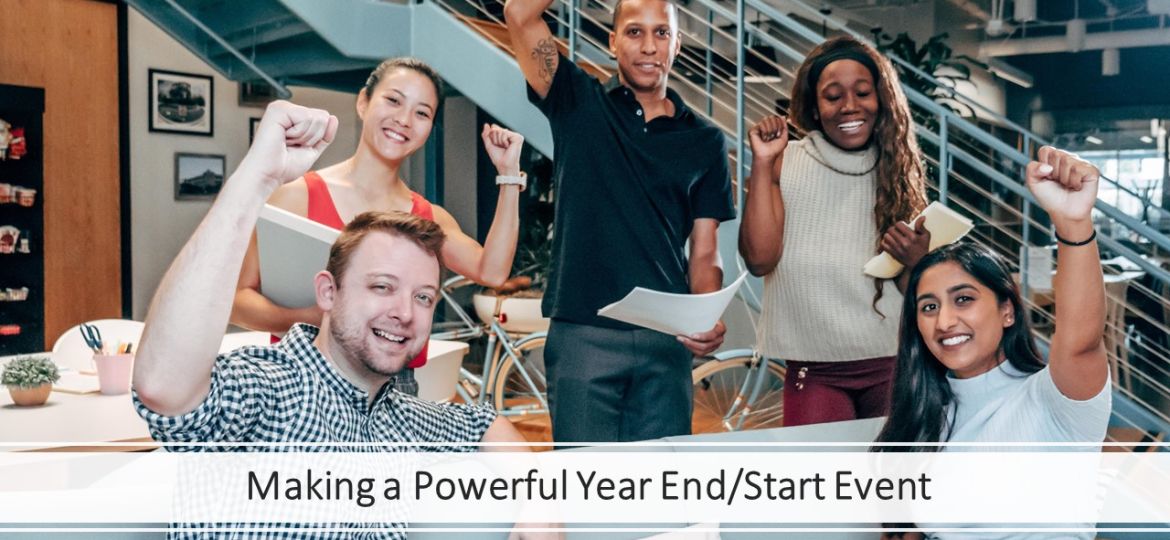
    A Meaningful Year End/ New Year Kickoff Event

    A year end event or a new year kickoff event must both heal and strengthen the emotional and mental health of the employees. And it doesn’t stop as an isolated event, but a continual development of leaders from an emotional intelligence perspective. The following are some tips for year-end or new year kickoff events:

    1. Know the emotional state of your employees: Implement an inclusive process to gather the emotional state of your team. Just like a doctor visit, you’ll need to know where people are with their emotional and mental health before prescribing an intervention. Measure key emotions like belonging, trust, safety (emotional, psychological, physical), etc. In addition, stress levels and the sources of stress are crucial for strategic interventions (i.e. StressEQ). Having tools and processes to get the heartbeat of your organization enables leaders to take focused action along with a much needed feedback loop.
    2. Integrate organizational needs with employees’ emotional needs in the event: The amount of uncertainty and stress requires leaders to integrate all needs, including those at the individual level, team level, and organizational level. Design the event to be inclusive and truly consider the needs of the individual. This would happen at the content level, as well as how it will run.
    3. Design activities to meet emotional needs: This is where emotional intelligence makes a huge impact, creating meaningful activities that drive long term results. The current environment demands a lot more than the standard fun element. It needs to help people bond. Depending on the findings from Step 1, inclusive activities can begin the healing process.
    4. Create/enhance processes and systems: The year end and/or new year kick off event is only a starting point. If no changes happen in processes and systems, your employees will not take it seriously. You don’t want people to see it as another fun event. Collaborate with leaders to enhance how basic tasks are accomplished. Dealing with the current emotional and mental health of your employees calls for consistent engagement, not just a single event.
    5. Develop leaders to achieve a culture of belonging and inclusion: To walk the talk of any leadership approach, those in management positions must execute from a leadership perspective. They will need to shift traditional reactive management approaches to proactive leadership processes and systems. Leaders can practice daily emotional maintenance task for themselves as well as their team members. We all spend time each day to do physical maintenance like brushing your teeth. Yet most do not take even five minutes to practice emotional maintenance. For example, before starting a meeting, ask everyone to share their emotional state. Enabling people to share their emotions creates focus; knowing the emotional state of the team enables leaders to strategically navigate employee attitudes.

    In the past, companies have invested millions of dollars in these events. While they were fun, how many tangible and sustainable results were achieved from these events? The expectation of these events cannot simply be to have fun and boost morale in the short term, the current environment demands a systemic approach to healing the emotional and mental state of employees.

    A systems approach goes well beyond surface numbers. For example, many diversity, equity, & inclusion initiatives may hit diversity quotas, but they fail to systemically shift how the organization achieves an inclusive culture. A Harvard Business Review article found that many minority leaders are struggling to thrive, feeling isolated and decreasing in confidence. The article concluded that caring leadership is the key. While easier said than done, the year end or new year event is a major element of showing care for the employees. Afterwards, continued development of leaders can help employees to feel safe, to be visible, and to be supported, especially in the remote workplace, where new skills are required.

    To learn more about these strategies and tactics which are included in our comprehensive solutions, contact us

    [/vc_column_text][/vc_column][/vc_row]

  • From Carbon to Culture: Unveiling the Complexity of ESG

    From Carbon to Culture: Unveiling the Complexity of ESG

    [vc_row][vc_column][vc_column_text]

    [/vc_column_text][/vc_column][/vc_row][vc_row][vc_column][vc_column_text]

    From Carbon to Culture

    Unveiling the Complexity of ESG Scores from a Leadership Perspective

    By Dr. Ted Sun

    Recently featured in Forbes

    The movement towards sustainable capitalism is getting more attention as younger generations demand deeper purpose in their work and consumers are expecting companies to go beyond a focus in profits. Environment, Society, and Governance (ESG) initiatives mark the latest efforts to quantify sustainable capitalism using ESG scores. As ESG investing continues to gain popularity, how should organizational leaders strategize their commitments to the pubic and their employees with integrity?

    With ESG scores, sustainable capitalism is here to stay. Numerous major corporations have made clear commitments regarding their environmental impact. For example, in consideration of beef’s huge carbon footprint, McDonald introduced the “McPlant” burger in early 2021, GM has committed to produce vehicles with zero-emissions by 2035, while United Airlines pledged to be 100% green with reducing its greenhouse gas emissions 100% by 2050. The list goes on, with many major corporations making various commitments towards sustainable capitalism.


    On the surface, these commitments are inspiring. Strategic leaders are constantly pondering how such lofty goals can be realized. While it’s easy to make bold statements about a future that’s far away, the path to ESG performance starts with an ESG culture of innovation. It will take countless innovations to realize these lofty environmental goals and thrive in complex business environments. This is where the society and governance pillars of ESG can help an organization achieve its goals. Within these two pillars, the organizational culture empowers every employee to contribute with the diversity of their ideas. This article provides the systemic insights towards the ESG culture that are necessary to excel in sustainable capitalism.

    ESG Literature

    Current literature on ESG is confusing, to say the least. No standard exists for ESG scores. The following major ESG scorers have their own mechanism: Bloomberg, Corporate Knights, Sustainalytics, Dow Jones, Thomson Reuters, and RepRisk. Intriguingly, the metrics for ESG scores are all latent metrics at the organizational level. For example, greenhouse gas emissions are latent environment metrics that looks at the environmental impact of the company. Employee turnover or injuries are latent social metrics that indicate the social impact of the company. Executive compensation is a latent governance metric that provides an insight to the governance impact of the company. With all these latent metrics, by the time one takes the measurement, it’s too late to make changes. The use of latent metrics by the major ESG players requires organizational leaders to work at the people systems level. Regardless of the latent metric, it requires systems and processes that guide the ESG culture of the company. This is where the rubber meets the road. Individuals, regardless of their role or position, having healthy perceptions of reality, utilizing systemic thought processes, and making wise decisions towards a set of sustainable strategies and practices which compound into inspiring ESG scores.

    Environment: From Goals to the Synergy of Action

    The environmental pillar of ESG has been around since the early 1990’s when Corporate Social Responsibility (CSR) began to gain popularity. For the most part, technology has been a major driver for companies to minimize waste, reduce consumption, and maximize recycling. Studies around carbon footprint have given stakeholders an objective view of a company’s cost of existence. The metrics concerning the environment occur at the organizational level. What is often missing is what happens at the individual level. Consider the thought process of employees, before they hit the print button of a document, or before they leave the office. How are they considering waste and consumption while at work? Now explore the same employee making decisions in their personal life. What type of vehicle is being driven and its impact on the environment? Are lights being turned off when they leave the room? How are they watering their lawns in the summer?

    I recently had an interesting discussion with a few executives about their consumption of bottled water and snacks. On the surface, they made great decisions to buy from vendors who use recycled plastics and wrappers. What they failed to realize is that the consumption of products like bottled water is unnecessary. A little bit of pre-planning for drinking water has worked for centuries in human history.

    Countless decisions we make impact the environment. As consumerism dominates the marketplace, employers who empower their employees to make conscious choices will be gifted with countless innovations that save the environment. The synergy realized in collective action by all employees is what makes a much larger environmental impact. Building off of a mentality of conscious decision also assists in ethics and how we build relationships. This is where the development of organizational culture that inspires conscious decision making will drive significant success.

    Social: From Goals to the Thought Process Development

    The social pilar of ESG focus on human rights, safety, diversity, and development. As one of the softer concepts, it is more challenging to measure. The major ESG scorers use metrics such as injury rate, employee turnover, diversity, and talent development. This pilar also includes much of the efforts within the Diversity, Equity, and Inclusion initiatives. One fascinating aspect about the social pillar is the systemic nature that requires changes in systems, not just latent metrics that could be misleading. At the system level, it’s about how individual employees continue to learn and grow. Most corporations have endless training and awards certificates; very few have an accountability structure to apply. A learning system would require organizations to have a talent inventory which tracks the skills developments, not a simple training transcript that rarely equate to real skills. To impact metrics like injury or fatality rates, developing a culture of safety requires a constant learning system. To impact employee turnover, an inclusive culture with daily leadership actions can engage employees to have a sense of belonging.

    The social pillar of ESG requires leaders to think differently about who they are, how they want to be remembered, and what kinds of systems and processes need to be introduced to develop their employees. The development of thought process calls for a higher level of self-awareness, starting with one’s core values and beliefs. This will be the lens that enables leaders to make remarkable decisions about labor practices that impact the people.

    Governance: from Goals to the Systems that Guide People

    The governance pillar of ESG is the most complex, since it deals with how executives make decisions to abide by regulations and operate their organization. When looking at metrics like board diversity, executive compensation, ESG strategy, bribery and corruption, they are not just something an individual decides, but requires consistent contribution from all levels of leadership. Unfortunately, most organizations continue to use management principles that have a few individuals making decisions for the masses. This provides a huge opportunity for systems to be introduced that guide the thoughts, decisions, and behaviors of all leaders.

    With the various metrics in the governance pillar, exploring the why and the how for each requires systems thinking. For example, policies against bribery and corruption often fall to the rule of “you get what you focus on”. Instead, create systems that inspire every employee to be at their best. When we speak to the term systems, it requires a constant feedback loop that informs people how to improve in the next situation. It is not a process that one goes through once a year like an annual performance review. It is something that gives people frequent feedback, so they are challenged to improve in the future. Systems like promotion systems, inclusion systems, and board onboarding systems are all part of this pillar waiting to be designed and implemented. Especially within the current post-pandemic environment, every company demands more innovation. A leadership development system that molds leaders into systemic thinkers is the minimum requirement for success and abundance of innovation in any organization.

    Designing your ESG Culture

    ESG is not just about the environment and some latent metrics. It is not about how much is thrown at a problem without accountability to actual changes in organizational systems.  It is about how people think, live, work, and make decisions that influence our long-term success as a planet, a company, and a family.  It’s about securing a future for our children. The outcomes of all organizational efforts start at the individual level. When we create a conscious and wise ESG culture within any organization, the goals for ESG scores can easily be achieved. Leaders with integrity and wisdom understand that throwing money at a problem never works. Instead, they take daily actions to drive a culture that makes sound decisions that balance the needs of the planet, our society, and profitability. Let’s work together to empower more leaders to think systemically about their actions that guide a powerful ESG culture.

    Click here to learn about our Systemic ESG Solutions.

    [/vc_column_text][/vc_column][/vc_row]

  • Dangers of the Conventional DEI Initiatives

    Dangers of the Conventional DEI Initiatives

    [vc_row][vc_column][vc_column_text]

    [/vc_column_text][/vc_column][/vc_row][vc_row][vc_column][vc_column_text]

    Dangers in the Conventional DE&I Initiatives

    Getting at the Root Issues

    By Dr. Ted Sun

    On a Thursday, a team of a major corporation was asked to work on Saturday due to customer needs. Two of the team members refused to do so and claimed they were being demanded to work extra because of their race. Management backed down immediately and let them off. On that Saturday, the rest of the team showed up and found out that they had to pull the weight of the two team members because they pulled the race card. This angered them incredibly. Two rifts tore up the cohesive culture that once existed.  The first rift is between the majority of the team and the management for special treatment. The second rift is between the majority of the team and the two who made the request to work extra into a race matter.

    In another organization across the nation, a team building exercise was taking place after lunch outdoors. A chipmunk picking up scraps of lunch scurried across the training area, visible to everyone. One individual cried out, “look out, a rat”.  Everyone immediately laughed at the humor of someone calling a chipmunk a rat. They quickly found out that this individual had never seen a chipmunk before and simply assumed it was a rat, which is perfectly natural.  At the end of the day, this individual reported the incident to the chief diversity officer as a racial incident against him. Once again, a rift between the individual and the rest of the group became an undesired outcome for the organization.

    Across our nation, situations like this is destroying the workplace culture and creating a significant rifts between people. While the movement in Diversity, Equity, and Inclusion is supposed to create equal opportunity for everyone, the conventional approach has led to numerous rifts between people. How did we get here when the goals of DEI are so pure? How do we create cohesive teams that work together towards common goals of the organization and of diversity, equity, and inclusion?

    Root Causes

    Root cause #1: DEI training – in most organizations, DEI training is an annual event that compromise some videos and readings with short quizzes to ensure short term regurgitation of materials. Much of the training looks at behaviors alone, leaving out the most important aspects of perceptions and thought processes which drive behaviors. While the theories presented in the training make sense, it rarely makes it into long term memory. For some, they are only left with a negative emotion of fear. Don’t let DEI issues come up.  For others, they see it as a tool to drive change. Unfortunately, without effectively enabling healthy perceptions and thought processes, wildly applied behaviors are ripping organizations and teams apart.

    Root cause #2: The blame game – this has been a common challenge that existed in US culture for many decades. As a litigious society, blaming others is common. With the current DEI movement, many people are becoming aware of title 7 through various zoom meetings and media outlets. In some of these meetings, title 7 is deemed a weapon of choice against management. This awareness has given people of minority groups another tool to fight individual discriminatory incidents. Unfortunately, the perception of an incident has expanded to anything. Instead of pinpoint accuracy to fight racism, it is appearing in many situations and dividing teams.

    Root cause #3: The quota game – many organizations are playing the quota game to meet the surface numbers in employment. One multi-billion dollar corporation created a Chief Diversity Officer at a salary of just above $300,000. Yet, the role only had $100,000 annual budget to address DEI issues. At the organizational level, the size of the budget reflects how seriously this corporation was taking DEI. But it met the quota at the C-level to have higher minority percentages. This is happening across many levels of countless companies. Often, the salary for such various positions is higher than those who have been working in similar roles. Imagine being the employee who have worked hard to achieve specific skills and accomplishments for a few years. Now you see others being hired getting paid more without having proven themselves, and at times don’t meet the qualifications. What happens to teamwork when the organization places people into such predicaments? Emotions of jealousy, anger, entitlement are never the goals of any leader.

    Systemic Solutions

    DEI is becoming a huge problem for many organizations across our nation. The examples mentioned above are all real incidents with people like you and me. With all the generic training around DEI, leaders are not coming close to addressing a systemic issue of racism. One time training events towards people are not systemic! The box-checking approach with DEI training and quotas are only getting organizations into massive problems in productivity, teamwork, and innovation. How are we going to continue to lead the world as innovative companies?

    The answer is a values-based systemic approach to DEI. Within this approach, DEI starts with understanding and recognizing the core values of individuals. Since core values plays a major role in how we perceive reality, higher level of awareness creates a systemic change in how you see others and situations. This is the path towards addressing issues of unconscious bias which takes months to years to enhance with strategic initiatives. Also at the individual level is one’s thought processes, which require higher emotional intelligence. In the previous incidents, recognizing that your emotions are hurt and knowing how to channel the emotion will be crucial to building solid relationships between people, whether that’s with management or your teammates. The one outcome that one never wants is to create a rift between team members.

    The systemic part of the approach must also include many organizational practices, procedures, and policies. This requires leadership development to embody, design, and implement inclusion throughout the organization. This is not an easy task when most have never experienced inclusive leadership (see article speaks directly to some secretes to developing inclusive cultures). The leadership development portion of the values-based systemic approach must go beyond generic behaviors like the past. On one hand, the content of leadership development program must address leadership beliefs that drive decisions. On the other hand, how the program is delivered must reflect inclusive principles, which is very challenging when most are used people lecturing at them. When both the content and the delivery method are done properly, leaders can begin to walk the talk of DEI through inclusive processes that are fair and equitable.

    DEI is not just about quotas on the surface of employment numbers. It is about how people live, work, and make decisions that reflect principles of inclusion and the diversity of thought. Let’s go beyond the generic DEI training courses and begin a revolution in creating inclusive cultures.

    If you’re facing similar issues like those describe at the start of our article, or don’t wish to get trapped by such internal turmoil, reach out to us and let’s make a systemic difference.

    [/vc_column_text][/vc_column][/vc_row]